Across our city, more than 140 emergency and homelessness programs operate 24/7, supporting over 10,000 people each day with safe shelter, essential services, and compassionate care.
This work is made possible by dedicated and skilled staff whose empathy and commitment support some of Toronto’s most vulnerable residents every day. Especially during the winter months, your work is critical and deeply appreciated.
Emergency Shelter and Homelessness Service Worker Appreciation Week runs from January 19–25, 2026. In partnership with the City of Toronto, we invite you to join a series of virtual events created to celebrate you, support your well-being, and recognize the impact of your work.
CN Tower Lighting
In celebration of Emergency Shelter and Homelessness Service Worker Appreciation Week, CN Tower will be illuminated in blue and white on January 19th! A standard light show will grace the tower's pinnacle every hour beginning at sunset for 5 minutes, with additional displays on the half-hour mark.
Catch the spectacular lighting on CN Tower’s live webcam at https://www.cntower.ca/live-views
Toronto Sign Light up
The 3D Toronto Sign will also be lit in blue and white on January 19th, and it will stay on throughout the day.

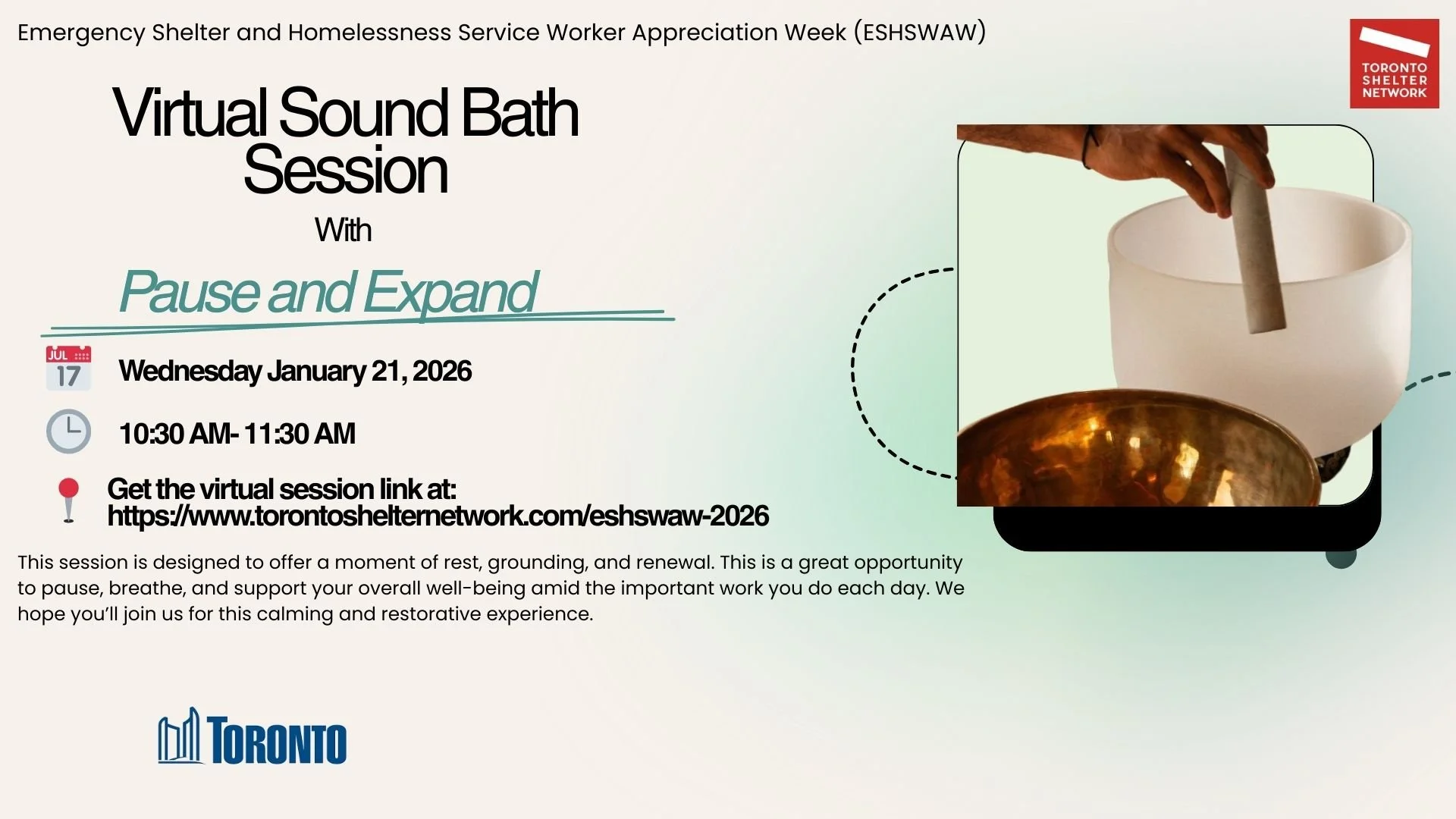
Emergency Shelter and Homelessness Service Worker Appreciation Session with Chris Leonard
This interactive session offers space to come together, reflect, recharge, and celebrate the incredible work you do. Chris Leonard brings an engaging and inspiring perspective that promises to make this a meaningful and energizing experience.
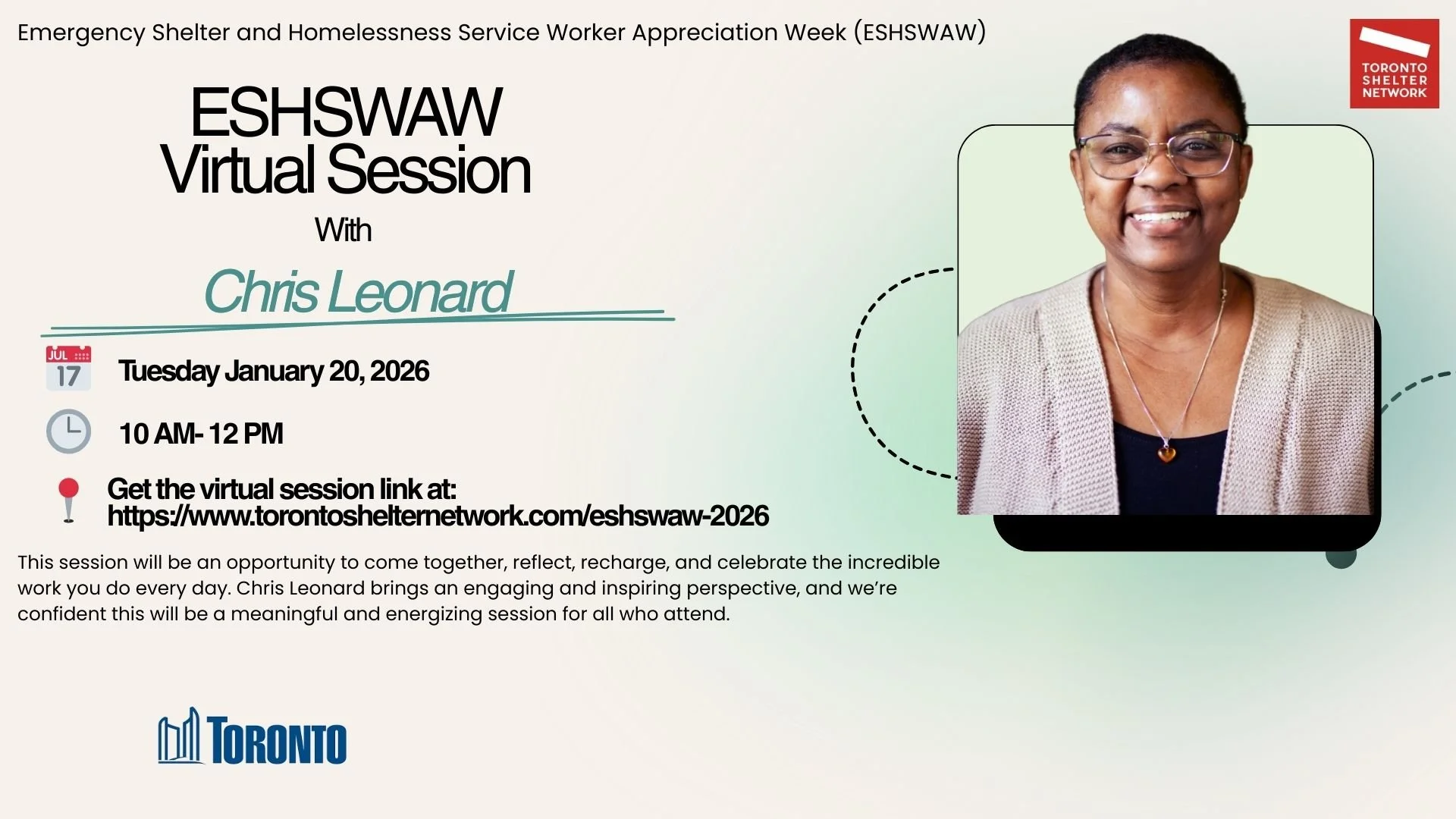
Virtual Sound Bath Session Presented by Pause and Expand- january 21
This calming session is designed to provide a moment of rest, grounding, and renewal. Join us for an opportunity to pause, breathe, and care for your own well-being amid the important work you do each day.
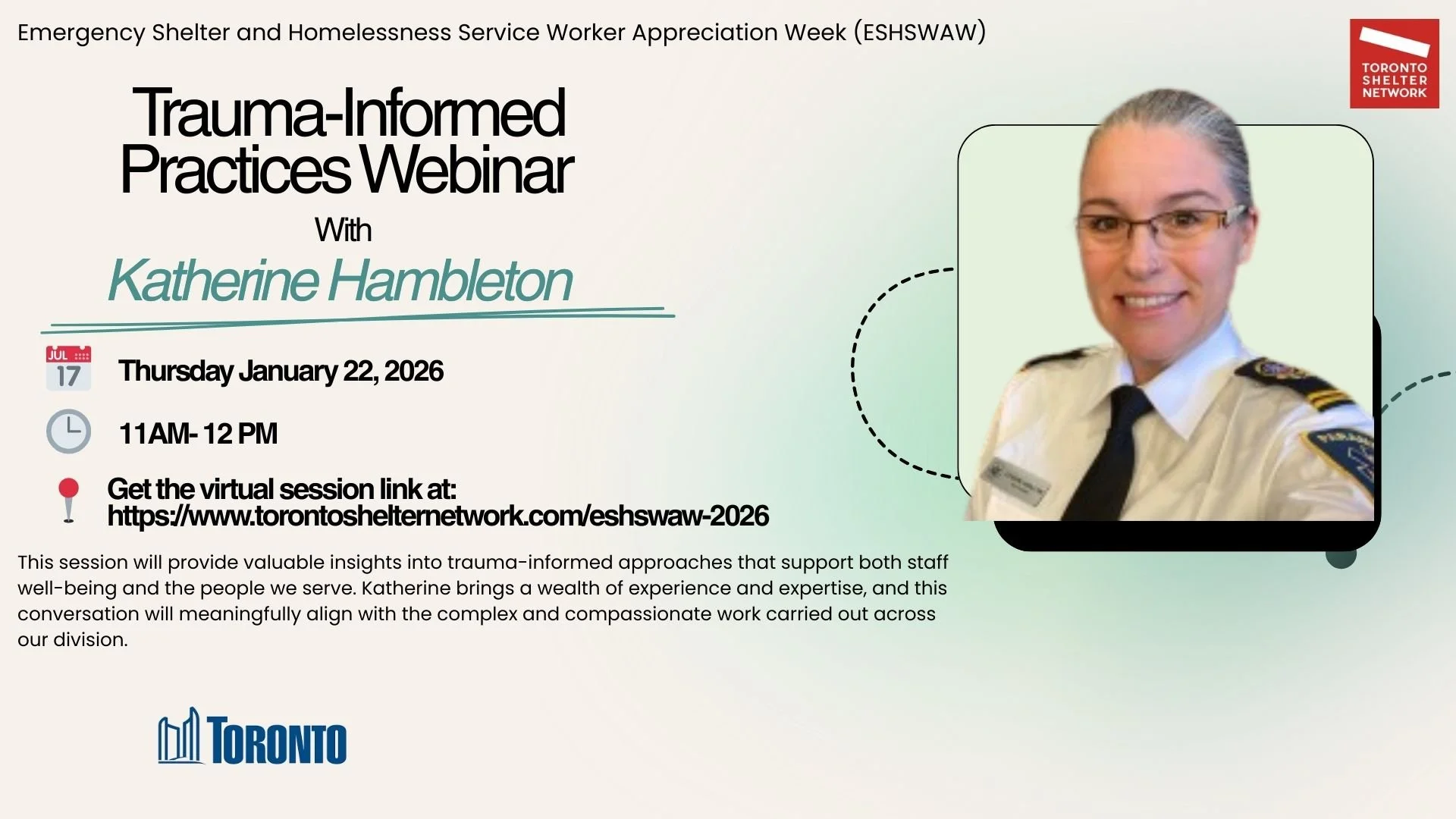
Trauma-Informed Practices Webinar with Katherine Hambleton- january 22
This session will explore trauma-informed approaches that support both staff well-being and the individuals we serve. Katherine, a paramedic, brings extensive experience and insight, and this discussion will strongly reflect the compassion, complexity, and care at the heart of your work.
Click here to view the recording of this session
Meet the Frontlines
We spoke with staff across the homelessness sector about their work, and we’re proud to showcase the incredible impact of homelessness and shelter workers throughout the sector.
Meet Julian:
Julian’s journey with The Scott Mission is one of resilience, compassion, and lifelong service. Originally arriving in Canada as a refugee from Colombia, Julian first encountered The Scott Mission as someone in need. Through interpretation services and access to the food bank, the organization supported him as he began building a new life in Canada. That experience would become the foundation for a career dedicated to supporting others experiencing homelessness.
Julian joined The Scott Mission as a support worker and, in 2007, transitioned into a full-time front-line counselor role, where he worked closely with shelter residents for many years. In 2019, he became Shelter Manager, followed by Director of Shelter and Respite in 2023. As of October 2025, Julian now serves as Senior Director of Operations, providing strategic and operational leadership to ensure high-quality, client-centred shelter services.
In his current role, Julian no longer works directly on the front lines, but his impact is felt throughout the shelter every day. He collaborates closely with the Shelter Manager and leadership team to identify opportunities to improve service delivery and to ensure residents’ needs and concerns are addressed with dignity and care. He also attends monthly house meetings with residents, creating space for open dialogue, feedback, and shared problem-solving. This open-door approach reinforces a culture of trust, transparency, and respect.
With over 20 years of experience in the homelessness sector, Julian has learned alongside key partners such as ARO, TSSSQA, TSN, IDEA, and other strategic collaborators. What continues to inspire him most is witnessing the transformation that can occur when people are met with compassion. Many guests arrive at the shelter exhausted, emotional, and broken from the experience of homelessness. Seeing their relief at simply having a safe place to sleep, and later watching them leave with renewed hope and stability is deeply meaningful. Knowing that the shelter played even a small role in helping someone turn their life around is one of the most rewarding aspects of his work.
Julian’s motivation to work in the homelessness sector is rooted in his personal history. Growing up around alcoholism, he developed a deep desire to help people affected by substance use and life instability. Today, rising levels of homelessness reinforce the urgency of the work. While the needs continue to grow, Julian believes compassion must grow even greater. By meeting immediate needs such as food and shelter, the team can then support longer-term healing through medical care, counselling, and spiritual care.
Data also plays a vital role in shaping shelter services. Regular resident and staff surveys help identify gaps and guide meaningful improvements, from culturally respectful meal planning to staff scheduling changes that have significantly reduced turnover. Data-informed decisions have helped create a more welcoming, trauma-informed environment, reduced service restrictions, and strengthened relationships between staff and residents. Yet, Julian is clear: no metric will ever outweigh the value of human connection.
At its core, Julian believes the work of shelters is about advocacy, humility, speaking for those who cannot, caring for those who feel forgotten, and breaking cycles of pain rather than perpetuating them. During Emergency Shelter and Homelessness Service Worker Appreciation Week, Julian’s story is a powerful reminder that shelters are not just places of refuge, but spaces of hope, transformation, and renewed possibility for both those who seek help and those who are called to serve.

Meet Grace:
Grace’s leadership in the homelessness sector is rooted in resilience, lived experience, and an unwavering commitment to social justice. With over 14 years of experience across housing, shelter operations, case management, and frontline service, she brings both strategic insight and deep compassion to her role as Director of Housing and Shelter Services at Street Haven, a position she has held since January 2023. She also holds a Master’s degree in Public Health, specializing in Health Promotion and Education, which informs her holistic, systems-focused approach to leadership.
Guided by integrity, transparency, and hard work, Grace leads by example. In her role, she provides strategic oversight of housing and shelter programs, ensures compliance with sector standards, and collaborates closely with staff, funders, and community partners to deliver high-quality, client-centred services. Her days include program planning, staff supervision, service oversight, and relationship-building, all grounded in her commitment to psychological safety and inclusive workplace culture.
What Grace finds most rewarding is witnessing transformation. Particularly when women and youth move from homelessness into stability and renewed independence. Seeing individuals reclaim their sense of dignity and possibility reinforces why she does this work. Equally fulfilling is cultivating workplaces where staff feel safe bringing their whole selves to work, knowing their voices matter and their contributions are valued.
The work is not without its challenges. As a Black woman leader of African descent, Grace navigates complex layers of intersectionality in a traditionally rooted sector. Championing Equity, Diversity, and Inclusion often means challenging long-standing norms and advocating for change that may feel uncomfortable to some. Rather than relying solely on policy, Grace focuses on shifting mindsets through transparency, empathy, education, and open dialogue, ensuring inclusion is a lived practice, not just a statement.
Grace’s motivation is deeply personal. Growing up in a community where women were marginalized and subjected to harmful practices such as child marriage and female genital mutilation shaped her lifelong commitment to empowering women and advancing systemic change. Today, she sees these same vulnerabilities reflected in the experiences of women facing homelessness amid a housing crisis that has left women’s shelter spaces critically limited.
For Grace, shelter work is about far more than providing a bed, it is about creating spaces rooted in dignity, cultural safety, and trauma-informed care. By fostering trust, empowering staff,
and centering safety and equity in service delivery, she helps create stronger teams, more responsive programs, and better outcomes for the women served.
As Emergency Shelter and Homelessness Service Worker Appreciation Week reminds us, leaders like Grace exemplify what makes this work so vital. Her message to the public and decision-makers is clear: “Homelessness is not just a housing issue, it is a human rights issue. Behind every statistic is a woman with resilience, dreams, and potential. Addressing the housing crisis requires compassion, systemic change, and sustained investment in supportive services. When women are empowered and provided with safe spaces, entire communities are strengthened. That is the legacy worth fighting for.”

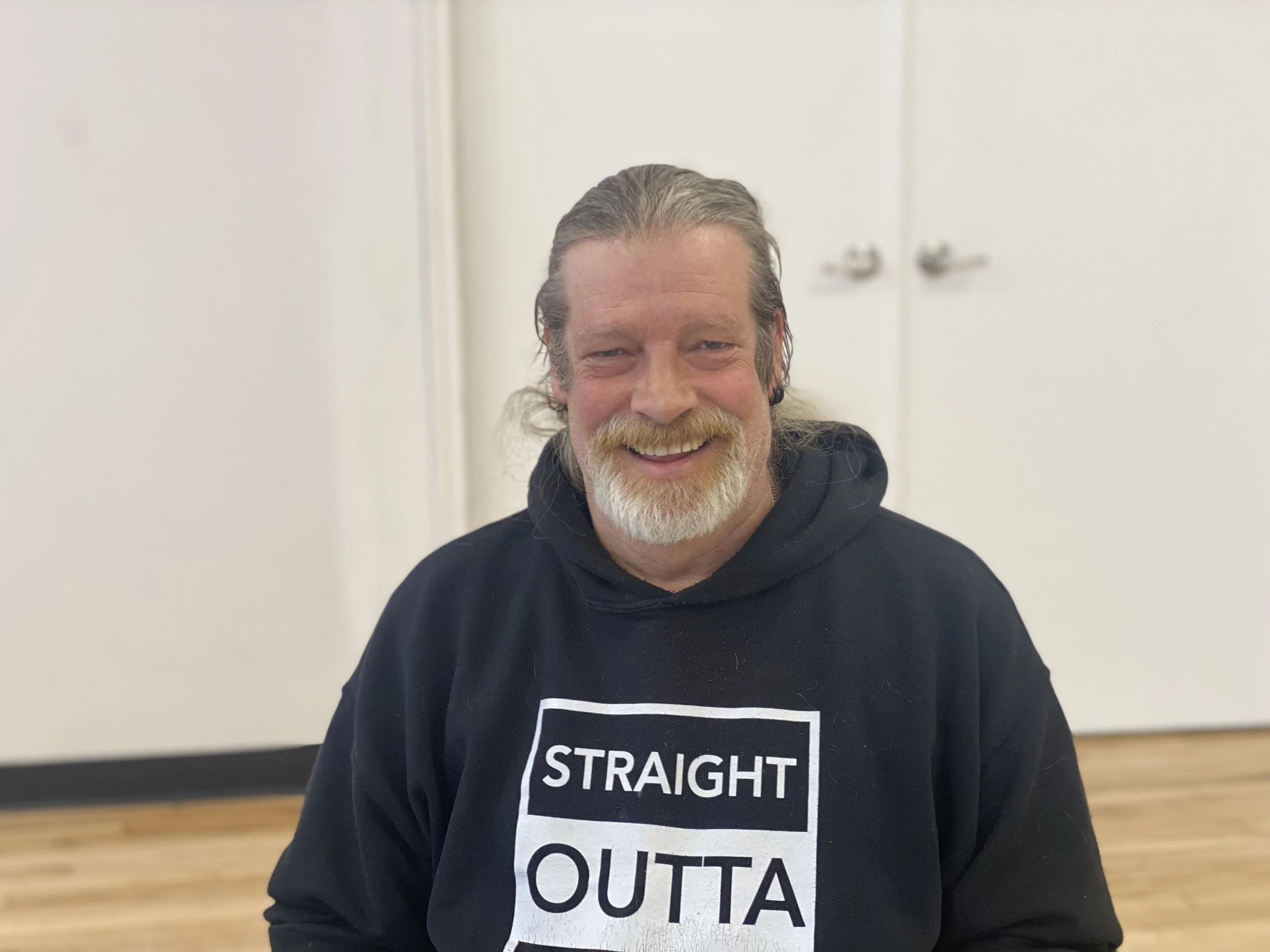
Meet Jim:
Jim’s story is one of lived experience, resilience, and deep compassion for others navigating homelessness.
Jim has been part of Toronto’s homeless community, both as someone in need of support and as someone providing it. Over the past 5.5 years, he has lived in shelters across the city, beginning at the Homes First Delta Hotel in Scarborough and currently residing at another shelter in North York. These experiences have shaped not only his understanding of homelessness, but also his commitment to supporting others facing the same challenges.
During this time, Jim found meaningful work within the sector, turning lived experience into a powerful source of connection and trust. He was employed with The Neighbourhood Group as a harm reduction worker and peer support worker, and later worked with University Health Network and an alcohol stabilization centre as a peer. In these roles, Jim supported people experiencing overdose, alcohol poisoning, mental health crises, and the overwhelming uncertainty that comes with navigating homelessness, often within hospital emergency rooms stretched far beyond capacity.
A typical day in Jim’s work meant meeting people at their most vulnerable moments: consoling individuals in crisis, helping them stabilize, and doing everything possible to support their next steps. It also meant confronting the harsh realities of a system with limited resources. One of the most difficult aspects of his role was having to tell clients that there were no shelter spaces available. Witnessing the sheer volume of people in need, while knowing housing options were scarce, took an emotional toll. As Jim explains, housing and mental health go hand in hand, and the absence of one often worsens the other.
Despite these challenges, the work remains deeply fulfilling. What matters most to Jim are the moments when things do work out: when a client makes progress, feels seen, or expresses gratitude for even a small act of support. Being told that he made someone’s day a little better, or helped create a sense of hope and optimism, is what makes the work worthwhile. At its core, this is human work, and that human connection is why Jim does what he does.
Jim’s journey into the homelessness sector began out of necessity. After losing previous employment during the COVID-19 pandemic and relying on CERB while living in a shelter, he was encouraged to apply for a Community Health Ambassador role. What began as a practical decision quickly became a calling. Being told he was a good fit, and then seeing how his lived experience helped others, cemented his commitment to the sector.
On the toughest days, Jim finds motivation in the feedback he receives from the people he supports. Knowing that others recognize his care and effort, and that he has helped create moments of happiness and optimism reminds him of the power of lived experience in frontline work.
Jim’s message to the public is clear: Homelessness is not something anyone chooses. Life can change quickly, and judgment only deepens harm. Compassion and understanding are essential. For decision-makers, his message is equally urgent, there are not enough shelter beds, not enough housing, and far more work still to be done.
During Emergency Shelter and Homelessness Service Worker Appreciation Week, Jim’s story reminds us that frontline workers are not only service providers, but advocates, peers, and sources of hope. Through empathy, lived experience, and dedication, Jim makes a real difference, one person, one moment, and one act of care at a time.

Meet Russell:
Russell’s work in the shelter and homelessness sector is deeply rooted in lived experience, resilience, and a lifelong commitment to giving back. As an individual in long-term recovery, Russell spent years navigating addiction and homelessness himself, including nearly a year as a guest at Good Shepherd. It was there, through the D.A.R.E Program, that he began his sobriety journey. That turning point not only changed his life, but also shaped his purpose. After completing the program, Russell returned to Good Shepherd as a volunteer, determined to give back to the very system that helped him survive and heal.
For more than 30 years, Russell has been connected to the homelessness and addictions sector in one form or another. Even during active addiction, he found himself trying to help others find shelter and support. Over time, that instinct evolved into a career. He began working in the addictions field and eventually transitioned into the shelter system, carrying with him decades of lived experience, empathy, and an unshakable belief in dignity as the foundation of recovery.
Today, Russell works in a dual role as both Supervisor and Support Staff, alternating responsibilities throughout the week. As a Supervisor, he is often the first point of contact at the intake desk, managing intakes, reports, shift notes, and responding to the countless issues that arise in a 24/7 shelter environment. When working as Support Staff, his focus shifts directly to the guests, ensuring their day-to-day needs are met and that they feel seen, supported, and respected. This balance allows Russell to stay connected to both operational oversight and front-line care.
Like many shelter programs, the site where he works initially faced some pushback from some members of the surrounding community. While he acknowledges that, in an ideal world, shelters would not be needed, they remain an essential support in responding to the homelessness and deeply affordable housing crisis our city is facing. Through sustained community engagement and the dedication of front-line staff like him, many community members have since become supportive of the shelter—or, at the very least, have developed a more positive and understanding view of its presence in the neighbourhood. One moment stands out above the rest: just before Christmas, students from a nearby school arrived dressed as elves, delivering a large handmade card signed by their classmates, thanking shelter staff for supporting the community. For Russell, that single act of kindness meant a great deal.
Russell believes that much of the resistance often seen when shelters are introduced into communities stems from a lack of accurate information. He emphasizes that the majority of the shelter’s guests are motivated to move forward into stable housing. While guests work toward that goal, shelter staff focus on providing dignity, stability, and a safe environment. He explains that when people are treated with respect and compassion, they are better able to support themselves and take meaningful steps toward leaving homelessness behind.
The most rewarding part of Russell’s work is witnessing progress firsthand. He has seen guests arrive seeking essential supports at a respite program and, over time, move into permanent housing. Others may not yet be ready for housing but are pursuing education or personal growth—important steps made possible by the safe and welcoming environment he and other dedicated staff help create. Seeing these moments of progress, no matter how small, reinforces why this work matters.
There are, of course, ongoing challenges. One of the most difficult is knowing how many people are seeking a safe place to stay while shelters remain consistently at capacity. Russell also reflects on his time supporting an Overdose Prevention Site, where he spent countless hours walking alongside guests—listening, speaking openly about recovery, and offering hope. Since then, he has witnessed some of those individuals achieve sobriety, moments that continue to stay with him.
Russell wears many hats beyond his shelter role. He is a union vice president, an addictions and mental health advocate, a mentor, and a sponsor to many people in recovery. On difficult days, what keeps him motivated is the simple reality that homelessness still exists. Seeing people sleeping outside reminds him why he must keep showing up and why more shelters and more compassion are urgently needed.
One story that stays with him is a former guest who struggled with both mental health and addiction. Russell spent significant time supporting her at the Overdose Prevention Site. Today, she is clean, sober, and housed. While he would never take full credit, Russell knows he played a small part in her journey, and that is enough.
Russell wants the public and decision-makers to understand that homelessness can happen to anyone. One financial decision, one life event, one health crisis can change everything. Shelters are needed, and the work cannot be automated or replaced by machines. This sector depends on empathy, lived experience, and human connection, things no algorithm can replicate. Shelter staff cannot force someone into housing or sobriety, but they can help people help themselves.
Without workers like Russell and his colleagues, shelters would not exist. And if shelters are pushed out by community resistance, the consequences are severe: more people will die on the streets. Russell urges communities to open their hearts and minds, to recognize that the people staying in shelters could be anyone’s child, sibling, or parent. The only difference between guests and their housed neighbors is a roof. Within the shelter, guests are given a roof they can call their own, along with dignity, safety, and hope.
During Emergency Shelter & Homelessness Service Worker Appreciation Week, Russell’s story is a powerful reminder that lived experience, compassion, and unwavering commitment can change lives, sometimes quietly, sometimes profoundly, but always meaningfully.